








Índice
- What is hash? Cannabis resin, not plant matter ›
- How is hash made? The two ways to separate resin ›
- Hand-rubbed hash: how charas is made ›
- How to make dry sift hash and kief ›
- How to make bubble hash with ice water extraction ›
- How to dry, smoke and use bubble hash ›
- How to make rosin, and bubble hash vs rosin ›
- Hash types compared: purity, effort and equipment ›
- Which hash is best for beginners? ›
- Is it legal to make hash? ›
Short answer: hash is cannabis resin pressed into a solid, and every method is just a different way to separate that resin from the plant. Four are worth knowing, and they run from your bare hands to a heated press:
- Hand-rubbed (charas): resin rolled off live plants by hand. The oldest method, no tools.
- Dry sift (kief): resin shaken through a fine screen, then pressed. The easiest to try at home.
- Bubble hash: resin frozen off in ice water and caught in mesh bags. Clean and potent.
- Rosin: resin squeezed out with heat and pressure. Sticky, solvent-free, full of flavour.
The resin itself lives in the trichomes, the frosted heads you can see on good flower under a cheap magnifier. That is where the cannabinoids and the smell sit, and it is the only part a hash maker actually wants. Our guide to trichomes goes deeper. Hold onto one idea and the rest makes sense: good hash is almost pure trichome, and cheap hash is trichome cut with ground-up plant. The second kind tastes of bonfire and does far less than it should.
What is hash? Cannabis resin, not plant matter
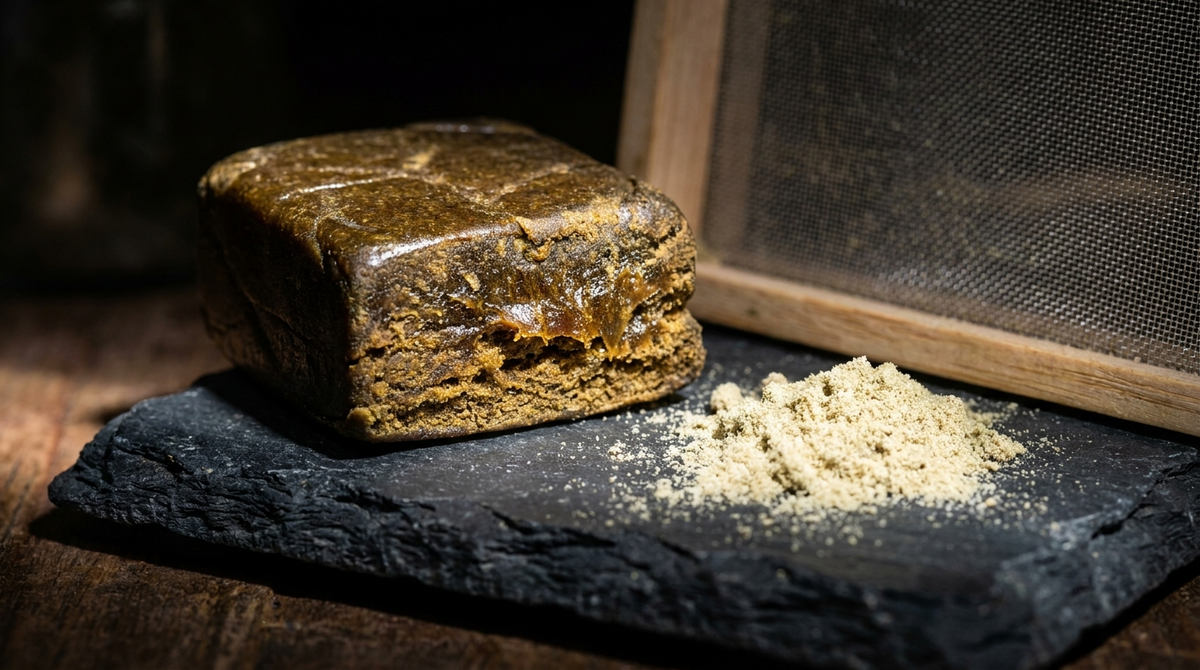
Hashish has been made for centuries, long before anyone could measure a cannabinoid. The reference entry on hashish calls it compressed resin glands, and notes the concentrate can carry far more THC than the flower it came from. That is the whole appeal. A little goes a long way. So the quality of any hash comes down to one question: how cleanly was the resin separated from the plant?
How is hash made? The two ways to separate resin
There are only two, and both are old. You either knock the resin loose while it is dry and brittle and then collect it, which is how charas, dry sift and bubble hash all work, or you press it with heat until the oils flow out and fuse, which is rosin. None of these use a solvent. Once you see hash as one goal reached two ways, the methods stop looking like separate crafts.
Hand-rubbed hash: how charas is made
Charas came first. In the mountains of India and Nepal, growers walk through living, flowering plants and rub the buds between their palms until fresh resin builds into a dark film on the skin, then scrape and roll it into soft balls. Nothing is added and nothing is filtered, so quality rests entirely on the plant and the patience of the maker. It does not scale, which is exactly why hand-rubbed hash is still treated as something special. You cannot rush it, and you cannot fake it.
How to make dry sift hash and kief
If you want to try any of this yourself, start here. Dry sift needs almost nothing, and it is the gentlest way in.
- Freeze well-cured flower for about an hour so the trichomes turn brittle.
- Rub or tumble it gently over a fine screen, roughly 120 to 160 microns.
- Collect the pale powder that falls through. That is kief.
- Press the kief with a little warmth until the grains bind into a solid block. Now it is hash.
Take only the first, cleanest pass and you get a light, delicate result, close to the mousse hash we cover elsewhere. Press it darker and harder and you move toward the traditional styles behind our look at black hash.
How to make bubble hash with ice water extraction
Bubble hash, also called ice water hash, is the modern favourite for clean results with no solvent. Weedmaps rates ice water hash among the purest concentrates you can make at home. The logic is simple: frozen trichomes are brittle, so agitating them in ice water snaps them off to be caught in a stack of mesh bags.
- Line a bucket with bubble bags, finest mesh at the bottom and widest on top.
- Add cannabis, ice and cold water, and keep it near freezing, around 0 degrees Celsius.
- Stir gently for a few minutes to knock the resin loose.
- Lift out each bag in turn. Every mesh size hands you a different grade.
- Press out the water and dry the hash slowly before use.
The best grades usually sit between 73 and 120 microns, because those screens catch mature trichome heads and leave the plant debris behind. It is the same idea as the classic ice-o-lator method, and it works even better from fresh-frozen material.
How to dry, smoke and use bubble hash
Fresh bubble hash comes out wet, and drying it properly is where most batches are won or lost. Spread it thin, keep it cold, and let it dry slowly over several days, or use a freeze dryer if you have one. Rushed, warm drying traps moisture and invites mould, which ruins the batch. Once dry, the highest grades are called full melt, because they melt cleanly on a hot surface and leave almost no residue.
Using it is flexible. You can sprinkle it over a bowl, add it to a joint, press it into rosin, or dab the full-melt grades. It is far stronger than flower, so start small. And if you are weighing bubble hash against kief: kief is dry-sifted resin, while bubble hash is ice-water-washed resin, and bubble hash is usually the cleaner of the two because the water floats off more of the plant matter.
How to make rosin, and bubble hash vs rosin
Rosin is the odd one out, because it gives you a sticky concentrate rather than a dry block. You press flower, kief or bubble hash between two heated plates. The heat melts the resin, the pressure pushes the oil out, and you scrape up something golden. Temperature is the whole argument: lower, around 70 to 90 degrees Celsius, keeps more aroma but less yield, while higher, near 100, pulls more but loses some smell. It helps to know what temperature THC evaporates at before you start.
So bubble hash vs rosin? They are relatives, not rivals. Bubble hash is the dry, collected resin. Rosin is what you get when you press that resin, or flower, with heat. Press bubble hash into rosin and you land on hash rosin, the top of the solventless world, alongside extracts like live resin.
Hash types compared: purity, effort and equipment
Here is the whole thing at a glance.
| Method | Equipment | Difficulty | Solvent-free | What you get |
|---|---|---|---|---|
| Hand-rubbed charas | Your hands | Slow, not technical | Yes | Tradition and aroma |
| Dry sift (kief) | A fine screen | Easy | Yes | The best starting point |
| Bubble hash | Bubble bags, ice, a bucket | Moderate | Yes | High purity |
| Rosin | A press or heated plates | Fussy about temperature | Yes | The cleanest, most flavourful result |
Which hash is best for beginners?
Dry sift, without question. It is forgiving, it costs almost nothing, and it teaches you what clean resin feels like. Bubble hash is the natural next step once you want real purity. Rosin is for people who have fallen for the flavour and do not mind chasing a few degrees. Charas is its own thing, and you already know if it is calling you. If you would rather skip the buckets and the freezer altogether, browse ready-made hash or the milder CBD hash.
Is it legal to make hash?
It depends entirely on where you live. Cannabis and concentrate laws differ from one country to the next, and making hash from THC-rich cannabis is restricted or illegal in many places. Treat this as an explainer rather than a green light, and check your local rules first. Because concentrates are far stronger than flower, start with a very small amount, and keep everything away from children and pets.