





Table of contents
- What Is the Endocannabinoid System and Why Does It Matter? ›
- What Exactly Is THC and Why Is It Psychoactive? ›
- What Makes CBD So Popular? ›
- What Is CBG and Why Is It Called the Parent Molecule? ›
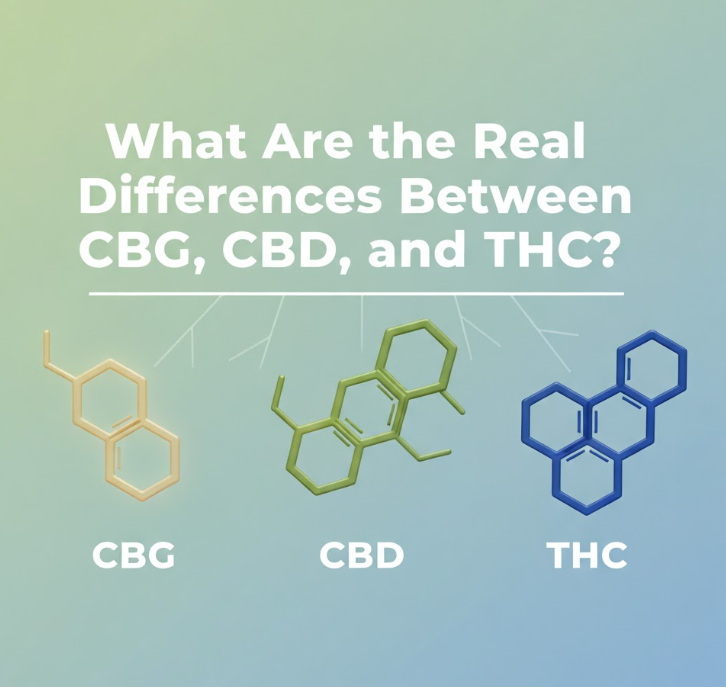
- What Are the Key Differences Between CBG, CBD, and THC? ›
- What Do Studies Say About Cannabinoid Research? ›
- How Should You Choose the Right Cannabinoid for You? ›
- What Does the Future Hold for Cannabinoid Research? ›
- Conclusion: Why Understanding CBG vs CBD vs THC Matters ›
- Works Cited ›
Understanding the difference between CBG, CBD and THC can feel confusing at first, because they all come from the same cannabis plant. These compounds are called cannabinoids, and each one has its own chemical structure and properties. This guide explains what each cannabinoid is, how it interacts with the endocannabinoid system and how the three compounds are regulated.
We explain what makes CBG, CBD and THC different, how they interact with receptors in the nervous system and what research can and cannot say about them today.
What Is the Endocannabinoid System and Why Does It Matter?
The endocannabinoid system (ECS) is a signalling network in the body. Researchers study its role in many physiological processes, such as memory and the regulation of body temperature.
How Does the ECS Work?
The ECS is made up of three main components:
- Endocannabinoids: Naturally occurring molecules that your body produces.
- Cannabinoid receptors (CB1 and CB2): CB1 receptors are found mainly in the brain and nervous system. CB2 receptors are found mainly in other tissues throughout the body.
- Enzymes: They break down cannabinoids after they’ve done their job.
Plant-based cannabinoids such as CBD, CBG and THC can interact with these receptors. How they interact depends on their chemical structure.
What Exactly Is THC and Why Is It Psychoactive?
THC, or tetrahydrocannabinol, is the main psychoactive compound in the cannabis plant. It is the compound that makes cannabis intoxicating.
How Does THC Affect the Brain?
THC binds directly to CB1 receptors in the brain. This binding changes perception and can impair concentration, memory and reaction time. For this reason, you should never drive or operate machinery after using THC.
What Does Research Say About THC?
THC is one of the most studied cannabinoids. In some countries, specific THC-based preparations are approved as pharmaceuticals for narrowly defined uses. These approvals apply only to those specific products.
Important points about THC research:
- Studies on THC use defined preparations and doses under controlled conditions.
- Results from these studies cannot be transferred to other THC products.
- THC can cause unwanted reactions, such as dizziness, a dry mouth or a fast heartbeat.
- Research is limited; no health claims can be made for THC products.
How Is THC Regulated?
The rules for THC differ a lot from country to country. Some countries allow hemp products with a very low THC content, while other cannabis products remain strictly regulated. The rules can change, so always check your local laws before buying or using products that contain THC.
You can see a range of cannabinoid products atCanapuff’s Psychoactive Collection. Check the rules in your country before you order.
What Makes CBD So Popular?
CBD (cannabidiol) is one of the best known cannabinoids. Unlike THC, CBD is not considered intoxicating. This is the main reason why CBD products are sold in many countries.
How Does CBD Work?
CBD does not bind strongly to CB1 and CB2 receptors. Instead, it interacts with the endocannabinoid system in an indirect way. Researchers are still studying the details of these interactions.
What Does Research Say About CBD?
Important points about CBD research:
- CBD is one of the most studied cannabinoids, but many studies are small or done in the laboratory.
- One specific CBD preparation is approved as a pharmaceutical in some countries for narrowly defined uses.
- This approval does not apply to CBD oils, flowers or other products sold in shops.
- CBD can interact with other substances, because it affects liver enzymes.
- Research is limited; no health claims can be made for CBD products.
What Is Hemp-Derived CBD?
Hemp-derived CBD is extracted from hemp plants that contain very little THC. The allowed THC limit for hemp products differs between countries, so check the local rules in your country.
You can find CBD oils and related products inCanapuff’s CBD collection. Each product page shows the cannabinoid content, and lab reports show what the product contains.
What Is CBG and Why Is It Called the Parent Molecule?
CBG (cannabigerol) is often referred to as the parent molecule of cannabinoids. In the early growth stages of cannabis and hemp plants, CBG acts as a precursor to other cannabinoids such as CBD, THC, and CBN.
How Does CBG Interact with the Body?
CBG is a minor cannabinoid, but it has its own chemical properties. Studies suggest that it binds partially to both CB1 and CB2 receptors. This is different from both CBD and THC.
What Does Research Say About CBG?
Important points about CBG research:
- Most research on CBG has been done in the laboratory or in animals.
- There are very few human studies on CBG.
- CBG is not considered intoxicating.
- Research is limited; no health claims can be made for CBG products.
How Does CBG Compare to CBD?
When we compare CBG vs CBD vs THC, both CBG and CBD are considered non-intoxicating. However, CBG appears to bind more directly to cannabinoid receptors than CBD. What this means for people is not yet known.
You can explore CBG and CBN options fromCanapuff’s Bestseller Collection.
What Are the Key Differences Between CBG, CBD, and THC?
Here are the key differences between the three compounds in a short overview.
|
Feature |
THC |
CBD |
CBG |
|
Type |
Psychoactive |
Not intoxicating |
Not intoxicating |
|
Receptor Interaction |
CB1 and CB2 (strong binding) |
Indirect interaction |
Partial CB1 and CB2 binding |
|
Main characteristic |
Changes perception |
Indirect action on the ECS |
Precursor of other cannabinoids |
|
Research status |
Widely studied |
Widely studied |
Few studies |
|
Regulation |
Restricted in many areas |
Rules vary by country |
Rules vary by country |
Some researchers discuss the so-called "entourage effect". This theory suggests that different cannabinoids and terpenes interact with each other. The theory is debated, and the evidence is not conclusive.
What Do Studies Say About Cannabinoid Research?
Cannabinoid research is growing fast. Many studies are done in the laboratory or in animals, and results from these studies cannot be transferred directly to people.
Some notable points:
- THC and CBD are the most studied cannabinoids.
- Research on CBG and CBN is at an early stage.
- Research is limited; no health claims can be made for CBG, CBD, THC or CBN products.
As interest in minor cannabinoids increases, more studies will probably be published in the coming years.
How Should You Choose the Right Cannabinoid for You?
The difference between CBG vs CBD vs THC matters when you choose a product. The most important factors are the cannabinoid content, the THC content and the rules in your country.
Consider These Factors:
- Cannabinoid content: Check how much CBD, CBG or THC a product contains.
- Lab reports: A certificate of analysis (COA) shows the exact content.
- THC content: Products with THC are psychoactive and strictly regulated in many countries.
- Product format: Oils, flowers, vapes and edibles differ in how they are used and stored.
- Local rules: Check the rules in your country before you buy.
Always consult a healthcare professional before starting any new supplement, especially if you take medications or have chronic health conditions.
Canapuff also offers other product categories, such as theCanapuff’s Kratom Collection and modern nicotine vape options inCanapuff’s Vape Collection.
What Does the Future Hold for Cannabinoid Research?
Cannabinoid research continues to grow. Scientists are studying how other cannabinoids interact with the endocannabinoid system. Many of these questions are still open.
The interest in hemp and in minor cannabinoids such as CBG is also growing. At the same time, the rules for these products are changing in many countries. Research is limited; no health claims can be made, so reliable lab reports and clear labels remain the most important information for buyers.
Conclusion: Why Understanding CBG vs CBD vs THC Matters
Each cannabinoid has its own profile:
- THC is psychoactive and strictly regulated in many countries.
- CBD is not considered intoxicating and is widely studied.
- CBG is the precursor of other cannabinoids and is still little studied.
Knowing these differences helps you understand product labels and lab reports.
If you want to compare cannabinoid products, visitCanapuff, where products come with lab reports that show their cannabinoid content.
Works Cited
- NCCIH. “Cannabis (Marijuana) and Cannabinoids: What You Need to Know.” 2024.
- WHO Expert Committee on Drug Dependence. “Cannabidiol (CBD) Critical Review Report.” 2018.
- NIH. “The Endocannabinoid System: Overview and Role in CNS Function.” 2023.
- Harvard University (HHP). Overview article on CBD products. 2022.
- U.S. Food & Drug Administration. “FDA Regulation of Cannabis and Cannabis-Derived Products.” FDA.gov, 2023.